RWA tokenization (Real World Assets)
Real-world asset (RWA) tokenization represents rights over physical or financial assets, such as real estate, debt, commodities or energy projects, as tokens on a blockchain; the legal regime depends on the asset and on the right the token carries. Unknown Gravity builds the technology for RWA issuances, and your counsel confirms how each token is classified.
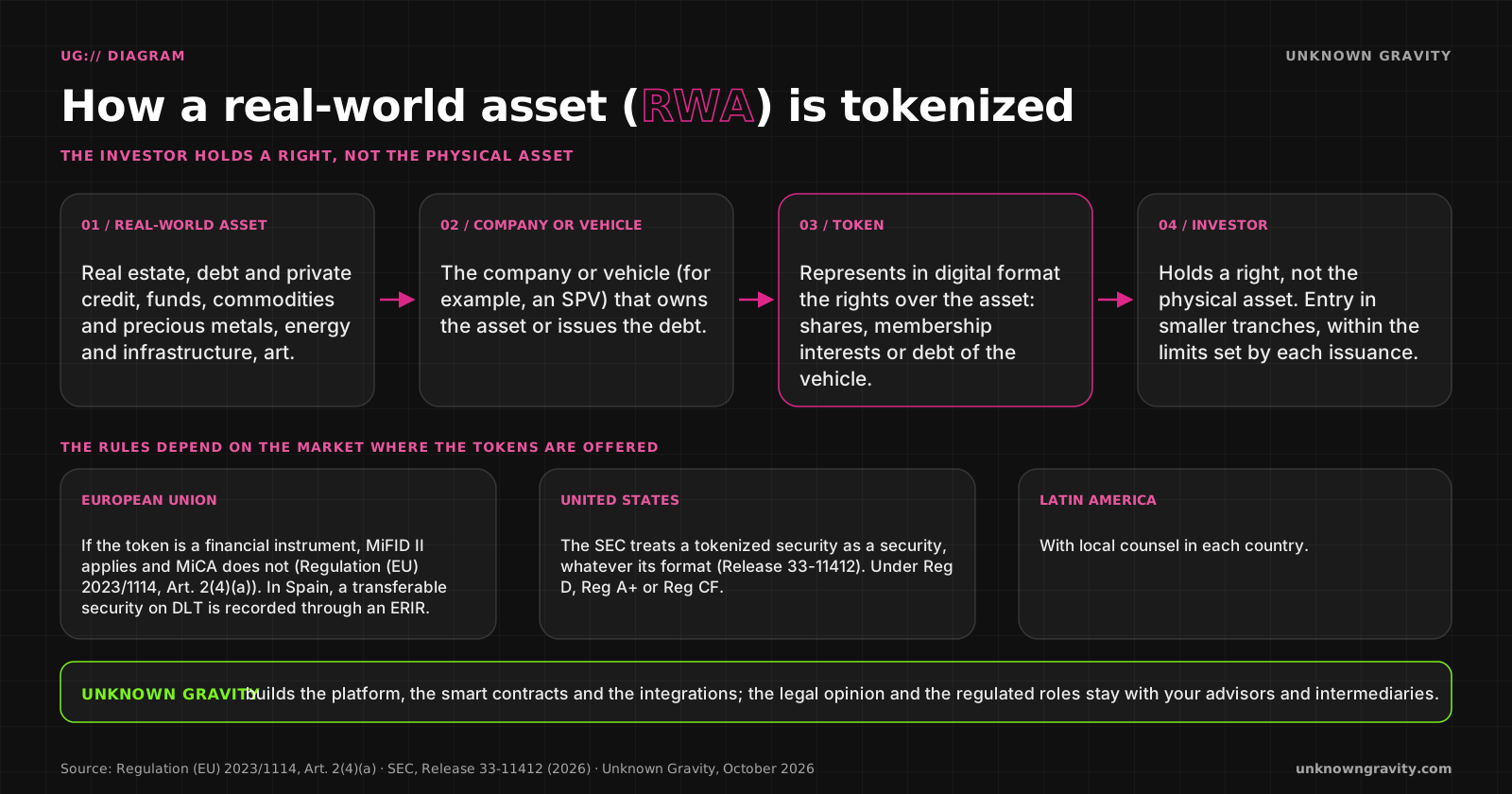
RWA tokenization represents rights over real-world assets (real estate, debt, funds, commodities or energy projects) as tokens on a blockchain, so that they can be issued, held and transferred under programmable rules. The asset itself is not digitized: what is tokenized is the right structured over it, within a legal vehicle.
We work with issuers in the European Union, the United States and Latin America. In every market the token is classified first, often as a security, and then it enforces the investor checks and transfer restrictions that classification requires. Liquidity is only potential: it exists where there is a market or a buyer to trade the tokens.
01 / What are Real World Assets (RWA)?
Real World Assets (RWA) are physical assets such as real estate, works of art, or financial products whose rights are represented as tokens using blockchain technology.
The process does not digitize the asset itself: it represents in digital format the rights structured over it, making it easier to buy, sell or invest within the corresponding legal structure. More on this in what RWAs are and what they are not.
Advantages of tokenizing your physical assets
- Entry in smaller tranches, within the limits set by each issuance.
- A traceable record of token movements; legal ownership is evidenced in the official register for each asset (Art. 3 of the Spanish Mortgage Act for real estate).
- International reach subject to the rules of each destination country and to the controls built into the issuance.
02 / RWA tokenization use cases and where we work
RWA tokenization is used in several industries, and in all of them the investor holds a right, not the physical asset.
- Real estate: shares, membership interests or debt of the vehicle that owns the property. In the United States this is a securities offering, usually through an SPV or a series LLC (see real estate tokenization in the United States).
- Debt and private credit: bonds or notes of a company or a vehicle, with interest and repayment programmed into the token.
- Funds: fund units or shares represented on-chain, which also follow the rules that govern the fund.
- Commodities and precious metals: depending on the token's terms, the holder may own allocated metal held by a custodian or only hold a claim against the issuer.
- Energy and infrastructure: financing for solar plants and other projects through debt or equity of the project company.
- Art and collectibles: fractional economic rights over a work held by a vehicle.
The rules depend on the market where the tokens are offered. In the EU, if the token is a financial instrument, MiFID II applies and MiCA does not (Regulation (EU) 2023/1114, Art. 2(4)(a)). In the United States, the SEC treats a tokenized security as a security whatever its format (Release 33-11412, 2026), and Reg CF is only open to issuers organized in the US, and Reg A+ to issuers organized and based in the US or Canada (17 CFR 227.100(b)(1); 230.251(b)(1)).
Where we work. We build the technology for RWA issuances in three regions. In the European Union, under MiCA and MiFID II and with an ERIR in Spain (see MiCA licensing by country); in the United States, with your securities counsel and under Reg D, Reg A+ or Reg CF (see asset tokenization in the United States); and in Latin America, with local counsel in each country (see asset tokenization in Latin America, country by country). We build the platform, the smart contracts and the integrations; the legal opinion and the regulated roles stay with your advisors and intermediaries.
03 / The tokenized RWA market in numbers
According to rwa.xyz, checked on October 15, 2026, tokenized RWAs distributed on blockchains total about $39.2 billion, and a little over a third is US Treasury debt. rwa.xyz is a private data provider: its figures are estimates that change daily, not official statistics. The Financial Stability Board (FSB) notes that comprehensive data on the scale and activities of existing tokens is lacking (report on tokenization, October 22, 2024).
| Category (as named on rwa.xyz) | Value (USD) | No. of assets | Share |
|---|---|---|---|
| US Treasury Debt | $14.9B | 108 | 38.0% |
| Commodities | $5.2B | 86 | 13.2% |
| Active Strategies | $4.2B | 50 | 10.8% |
| Stocks | $3.3B | 6,220 | 8.3% |
| Asset-Backed Credit | $3.0B | 36 | 7.5% |
| Specialty Finance | $2.7B | 14 | 6.8% |
| Corporate Credit | $1.7B | 88 | 4.4% |
| Real Estate | $230M | 83 | 0.6% |
| Other: private equity, venture capital, non-US government debt, diversified credit and others | $4.1B | 151 | 10.5% |
Source: rwa.xyz, distributed assets by category, checked on October 15, 2026. Rounded figures.
Three points to read the table:
- Distributed vs. represented. rwa.xyz calls "distributed" the tokens that investors can subscribe to and hold in their own wallet or with their custodian. Separately, it counts about $352.6 billion in "represented" assets, where the blockchain is only a recordkeeping layer and investors neither receive nor transfer the token; 88% of that figure is repurchase agreements (repos).
- No stablecoins. Stablecoins, about $292.4 billion according to the same source, are measured separately.
- One network holds much of the value. Ethereum accounts for 43% of the distributed value.
Real estate carries little weight in these figures: about $230 million distributed. Much of the value sits in money market and government debt funds, such as those we analyze in Ondo Finance and tokenized Treasuries.
04 / Examples of tokenized RWAs with a public record
An RWA example can be checked when the offering document or an official register states what the investor buys and who keeps the record. These four appear in a public register:
| Example | What it is | Where it is recorded | What you can check there |
|---|---|---|---|
| Franklin OnChain U.S. Government Money Fund (FOBXX) | US government money market fund, launched on April 6, 2021 | Prospectus dated August 1, 2026, on EDGAR (SEC) | It is a government money market fund under Rule 2a-7 of the Investment Company Act of 1940. Its transfer agent keeps the official record of share ownership in a system integrated with public blockchains, with Stellar as the primary network. |
| BlackRock USD Institutional Digital Liquidity Fund (BUIDL) | US dollar liquidity fund organized in the British Virgin Islands | Form D on EDGAR (latest amendment, filed July 27, 2026) | Private offering under Rule 506(c) (17 CFR 230.506(c)) and the Section 3(c)(7) exclusion of the Investment Company Act. Total amount sold reported: $5,135.5 million since the first sale (March 4, 2024), with 28 investors. According to the launch press release (March 20, 2024), it invests in cash, US Treasury bills and repos, and its tokens can only be transferred to pre-approved investors. |
| Azvalor Blockchain, FI | Spanish UCITS investment fund | CNMV register, No. 5982, dated October 3, 2025 | Manager: Azvalor Asset Management, SGIIC. Depositary: BNP Paribas S.A., Sucursal en España. According to an elEconomista article (October 7, 2025) reposted in its manager's press room, the units are recorded on a private blockchain network using Allfunds Blockchain infrastructure and, in this initial phase, the fund is not open for distribution. |
| Shares and bonds represented on DLT in Spain | Securities of Spanish companies recorded by an ERIR | CNMV official register (Art. 2(b) of Royal Decree 815/2023) | URSUS-3 Capital, A.V., S.A. is listed as an ERIR with 21 registered issuances as of October 15, 2026, 16 of them bonds. The CNMV warns that registration does not mean it has validated the terms of the issuance or the information provided by the issuer. |
None of these examples is an investment recommendation. They show two models: the regulated fund that uses a blockchain to record its units, and the issuance of securities represented on DLT with an ERIR in Spain (we explain it in ERIR firms in Spain).
05 / Risks and limits of RWAs
An RWA token is worth what the right it represents is worth, and it adds technology and legal-structure risks to the risks of the asset. Before issuing, review these points:
- Liquidity. Tokenization does not on its own turn an illiquid asset into a liquid one. Without a market or a buyer the token cannot be sold, and when it represents a financial instrument it is transferred within securities regulation, subject to the restrictions set by the issuance, such as an allowlist of identified investors. The FSB warns that if a token is perceived as more liquid than the asset backing it, redemption run risk may increase, and that permissioned networks may limit the development of deep secondary markets. We cover it in the secondary market for security tokens.
- Rights and ownership. Receiving or transferring a token does not in itself transfer ownership, which requires both title and delivery (Art. 609 of the Spanish Civil Code). For real estate, a sale executed as a public deed counts as delivery (Art. 1462 of the Civil Code), and registration at the Land Registry makes it enforceable against third parties (Art. 606 of the Civil Code and Art. 32 of the Mortgage Act). What is fractionalized are the rights over the asset within a vehicle: units, credit rights or rights to its income.
- Custody of the asset and of the keys. You need to know who holds the real asset and what happens if the custodian or the issuer goes bankrupt. For financial instruments on DLT, the CNMV considers that the loss or theft of keys should not mean the loss of the securities: the issuance smart contract must allow the ERIR to return them to their holder (CNMV Q&A on DLT-based financial instruments, question 27).
- Oracles and third parties. According to the FSB, tokens that represent an existing asset may need custodians, oracles that bring data on-chain for smart contracts, and ramps to the traditional financial system. If the oracle data fails, the contract executes on wrong data.
- Technology. The FOBXX prospectus lists, among other risks, delays if nodes cannot reach consensus, undiscovered technical flaws, compromised cryptographic security and network forks. The issuance code is reviewed before deployment (smart contract audits).
- Applicable rules. In the EU, if the token is a financial instrument, MiFID II applies and MiCA does not (Art. 2(4)(a) of Regulation (EU) 2023/1114). For a first analysis of a specific case, use the MiCA or MiFID II classifier.
We explain the EU framework for each type of asset in what RWAs are. If you are comparing providers, see our comparison of RWA tokenization companies. At Unknown Gravity we build the platform, the smart contracts, the transfer controls and the integrations for the issuance, together with the client's legal counsel and the authorized entities each case requires. Talk to us.
This content is for information purposes. It is not legal, tax or investment advice and does not replace consulting a professional. Regulation on tokenization and crypto-assets keeps evolving: check the current version of the rules cited on BOE and EUR-Lex.
FAQ
Frequently asked questions
What are RWA tokens?
They are tokens that represent a right over a real-world asset, such as a property, a bond, a fund or gold. The token is not the asset: its regime depends on the asset and the right it carries. If that right is a security, the token is a security token.
What assets can be tokenized as RWA?
Not just any asset. What is tokenized are rights over assets such as real estate, artwork, machinery or commodities, provided the right is identified, transferable and its ownership recorded in the relevant register. Financial products are not physical assets: they follow securities regulation (Arts. 2 and 6 of Law 6/2023 (LMVSI), BOE-A-2023-7053).
Is it legal to tokenize physical assets?
Yes, and what determines the applicable regime is not whether the asset is registered or certified, but which right the token represents, how that right is transferred off-chain, and whether the transaction falls under securities regulation. That classification is settled before issuing (Arts. 2 and 6 LMVSI, BOE-A-2023-7053; Arts. 609 and 1280.1 of the Spanish Civil Code).
Does RWA mean the same thing in banking as in crypto?
No. In banking, RWA means risk-weighted assets: the base on which a bank calculates its minimum capital, which for total capital is 8% (Art. 92(1) of Regulation (EU) No 575/2013). In crypto, RWAs are real-world assets represented as tokens.
Can you sell an RWA token at any time?
Not necessarily. It depends on whether there is a market or a buyer and on the rules of the issuance: if the token is a financial instrument, it is transferred within securities regulation and subject to the restrictions set by the issuance. In a tokenized fund, when and how units are redeemed is set by its prospectus, not by the token.
RELATED SERVICES
GUIDES AND COMPARISONS
YOUR PROJECT
Tell us what you need to build.
Two lines are enough. We reply within 24 working hours with a first assessment and, if it fits, a slot to talk.