Blockchain brings one concrete guarantee to data security: detecting that a record has been altered, because each block is cryptographically chained to the one before. The question to settle before any design is which data actually goes on-chain and which stays off, because what is written cannot be erased and that collides with data protection rules.
In the digital era, where data management and protection have become crucial imperatives, blockchain technology has emerged as a disruptive innovation.
At its core, blockchain is a decentralized and distributed registry that uses cryptography to ensure the integrity and transparency of stored information. Its unique architecture has transformed the way we think about data security, providing solutions that go beyond traditional methods.
The Importance of Data Security
Data security is a fundamental component in a world where information is a valuable and, at the same time, vulnerable asset. The growing threat of cyberattacks and the need to preserve privacy have catapulted data security into the spotlight.
In this context, blockchain is presented as an innovative response, offering not only an improvement in information protection, but also a paradigm shift in the way we approach security in the digital environment.
In this article, we will thoroughly explore the specific advantages that blockchain technology brings to data security, analyzing every aspect of its impact and relevance.
Advantages of blockchain technology
Immutable Blockchain Structure
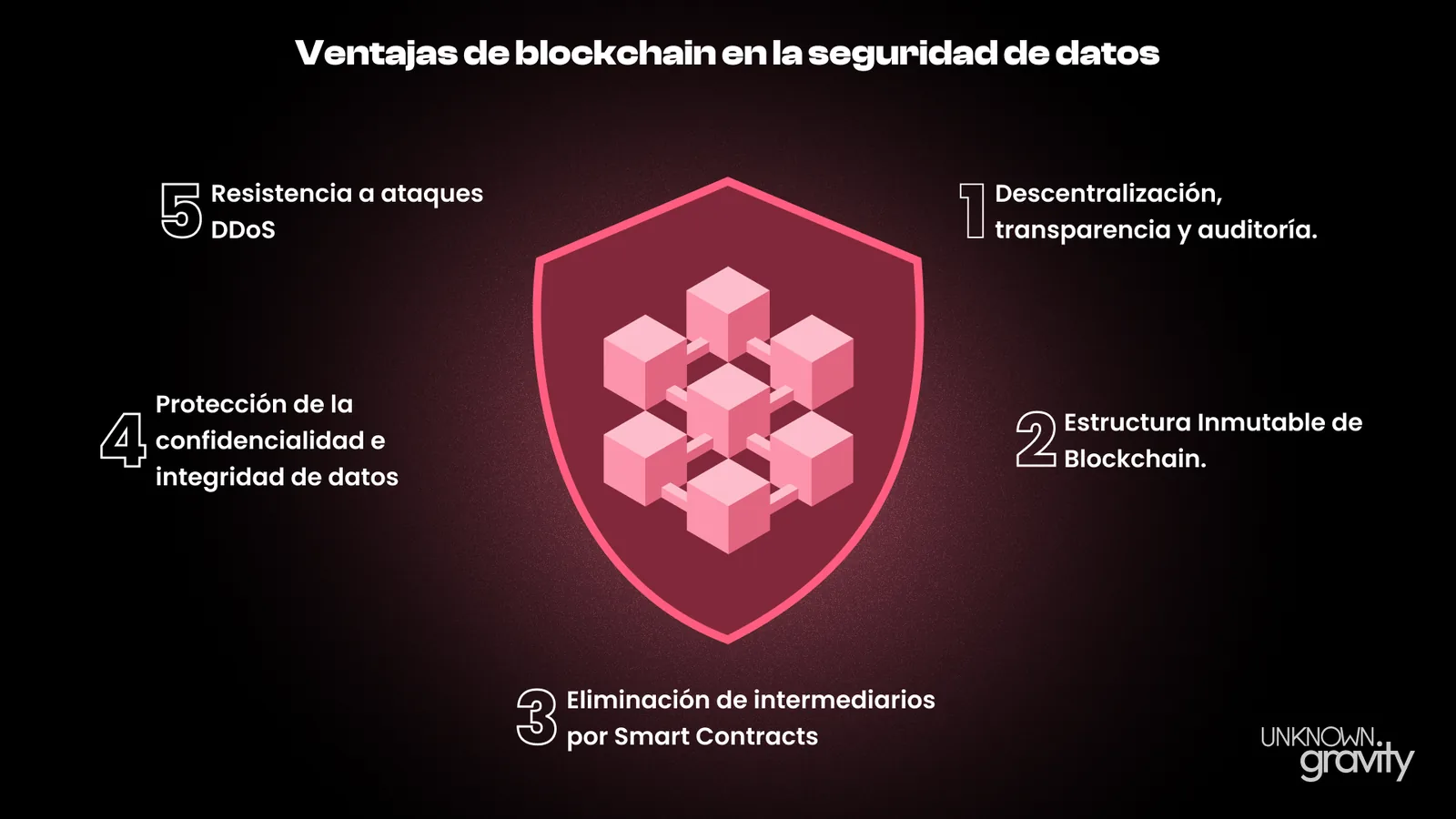
Immutability, as a cornerstone of blockchain data security, refers to the inability to modify the information stored once it has been registered in a block. Each block is cryptographically linked to its predecessor, forming a chain that, by design, is extremely resistant to unauthorized changes. This feature provides an additional layer of security, ensuring data integrity and reliability over time.
Information protection on blockchain is carried out using advanced cryptographic algorithms. These algorithms ensure that the information contained in each block is highly resistant to malicious manipulation. The application of robust cryptographic techniques not only protects against external attacks, but also guarantees the confidentiality and authenticity of the stored data.
The guarantee of integrity provided by blockchain is not limited to the time the data is created, but extends throughout the existence of the blockchain. Resistance to alteration provides confidence in the veracity of information, crucial in environments where data integrity is essential. This unique blockchain property becomes a bulwark against possible manipulations, providing an unprecedented level of security in data management.
Decentralization
Decentralization in blockchain represents a fundamental change in data management compared to conventional centralized databases. While the latter concentrated information on a single server or location, blockchain distributes the load across nodes of a decentralized network.
This decentralized approach not only improves the resilience of the system, but it also decreases vulnerability to possible attacks aimed at a single central point.
In blockchain, information is distributed among multiple nodes that participate in the network. Each node keeps its copy of the blockchain, meaning that the loss of a node doesn't compromise the overall integrity of the information. This decentralized distribution ensures that the network is resistant to individual failures and increases the reliability of the system as a whole.
Elimination of Intermediaries with Smart Contracts
Los Smart Contracts are stand-alone programs designed to automatically execute predefined actions when certain conditions are met. In the context of blockchain, these contracts are executed on the blockchain, offering an additional level of security in process automation.
The basis of its operation lies in the programming of contractual logic using code, eliminating the need for intermediaries and providing a secure and transparent way of carrying out agreements.
The automatic execution of smart contracts on the blockchain not only represents an advance in operational efficiency, but also involves a fundamental transformation in the structure of business processes.
By eliminating the need for traditional intermediaries, smart contracts reduce dependence on third parties in the execution and validation of agreements. This paradigm shift has profound implications for reducing risks and improving integrity in various transactions and business operations.
Transparency and Auditing
Transparency in blockchain is an essential feature that redefines data management. Every transaction made on the blockchain network is accessible to all authorized participants. This open access to information promotes trust between parties, as each entity can independently verify and validate transactions. Full visibility of operations contributes to building an environment of trust in data management.
Blockchain's intrinsic transparency facilitates auditing processes. Auditors can easily examine and verify transactions stored on the blockchain without relying on intermediaries. This efficient auditing capability not only simplifies compliance procedures, but it also sets a high standard for accountability and accuracy of recorded information.
Resistance to DDoS Attacks
The distributed nature of blockchain confers inherent resistance to distributed denial of service (DDoS) attacks. While centralized systems are more susceptible to traffic saturation, in blockchain, the load is distributed among multiple nodes in the network.
This decentralized approach significantly hinders the effectiveness of DDoS attacks by not concentrating processing capacity on a single point, allowing the network to maintain its functionality even under stressful conditions.
Resistance to DDoS attacks in blockchain translates into a greater capacity to withstand attempts to saturate the network. The distribution of information and processing power across numerous nodes makes it more difficult for attackers to overwhelm the network with malicious traffic. This essential advantage ensures that the blockchain can maintain its operability and availability, even in situations where centralized systems could collapse.
Protecting Confidentiality and Data Integrity
The application of advanced cryptography in blockchain goes beyond mere protection against unauthorized access. It guarantees the confidentiality of information by encrypting data so that only authorized participants can access it. In addition, it ensures that the data is not altered without authorization, thus preserving the integrity of the information stored in each block. These combined aspects establish a high level of security in data management in digital environments.
Immutability, as a cornerstone of blockchain data security, refers to the inability to modify the information stored once it has been registered in a block. Each block is cryptographically linked to its predecessor, forming a chain that, by design, is extremely resistant to unauthorized changes. This feature provides an additional layer of security, ensuring data integrity and reliability over time.
Limitations
Despite the numerous advantages offered by blockchain in the field of data security, its implementation is not without potential challenges and risks that must be addressed with caution and for this reason, we recommend that you contact experienced companies in the sector such as Unknown Gravity.
Recognizing these aspects is crucial to ensure effective and safe adoption of technology. Next, we'll explore some potential risks associated with implementing blockchain in data security:
1. Technological Complexity: The implementation and management of blockchain technology can be complex and require specialized knowledge. The learning curve for integrating and maintaining blockchain-based systems could present challenges, especially for organizations with limited resources.
2. Regulatory Compliance: Although blockchain guarantees transparency, this can clash with privacy requirements and regulations such as the General Data Protection Regulation (GDPR). Managing privacy and regulatory compliance must be carefully addressed to avoid potential conflicts.
3. Smart Contracts Security: Smart contracts, while powerful, can contain vulnerabilities if not properly developed and audited. Errors in the code can lead to serious consequences, compromising the security of information stored on the blockchain.
Conclusions
In this analysis of the advantages of blockchain in data security, it is clear that this technology not only offers incremental improvements, but also redefines the paradigm of protecting sensitive information in the digital age. Every aspect addressed, from immutability to resistance to DDoS attacks, has proven to be critical in creating a secure and reliable environment for data management.
The combination of features such as decentralization, transparency, advanced cryptography and automatic execution using smart contracts positions blockchain as an essential pillar at the forefront of digital security. Resistance to DDoS attacks, backed by the distributed nature of the technology, adds an additional layer of robustness, ensuring service continuity even under adverse conditions.
As blockchain technology evolves, a future is in sight where its innovative application will continue to strengthen data security in diverse industries, marking the path to a more secure and reliable digital era.